An office chair can slide under a desk when empty and still fail at the setting its user needs. Lowering the seat and armrests may make the chair easier to park, but it says nothing about whether the person can work close to the keyboard with relaxed shoulders and the backrest supporting them.
Before approving a chair for a fixed desk, bench or height-adjustable workstation, treat the chair and desk as one specification. The useful question is not simply “what is the office chair armrest height?” It is: will this exact arm option clear the desk’s lowest obstruction at the user’s working setting, through the movement the chair must make?
Set three pass conditions before measuring
“Fits under the desk” can describe three different outcomes. Record them separately so a parking demonstration is not mistaken for a completed workstation check.
| Fit state | What must happen | Typical false pass |
|---|---|---|
| Working fit | The user can bring the chair close enough for normal keyboard and mouse work while keeping their chosen seat and arm settings. | The chair clears only after the armrests or seat are lowered away from the working position. |
| Parking fit | The empty chair can be stored in the intended position without forcing it against the desk, pedestal or cable tray. | The arm pads pass the front edge, but the chair base or backrest remains in the aisle. |
| Movement fit | The chair can roll in, swivel for entry and exit, and use its intended recline without striking nearby furniture or under-desk equipment. | A straight-on photograph shows clearance, but the chair catches as soon as it turns. |
These states may produce different answers. That is acceptable if the project records the intended use. It is not acceptable to approve a large order from one unlabelled measurement.
Measure the desk from its lowest obstruction
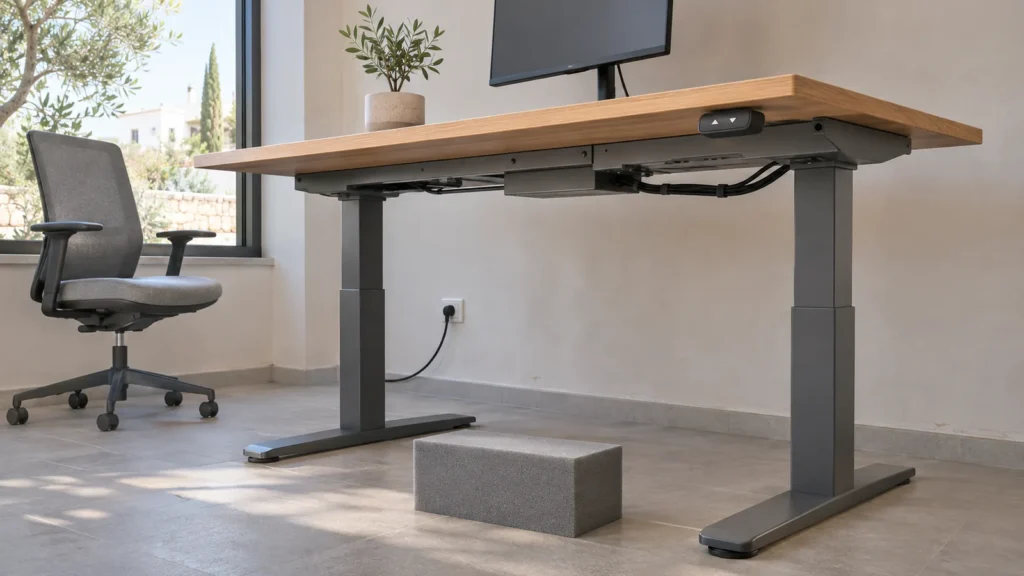
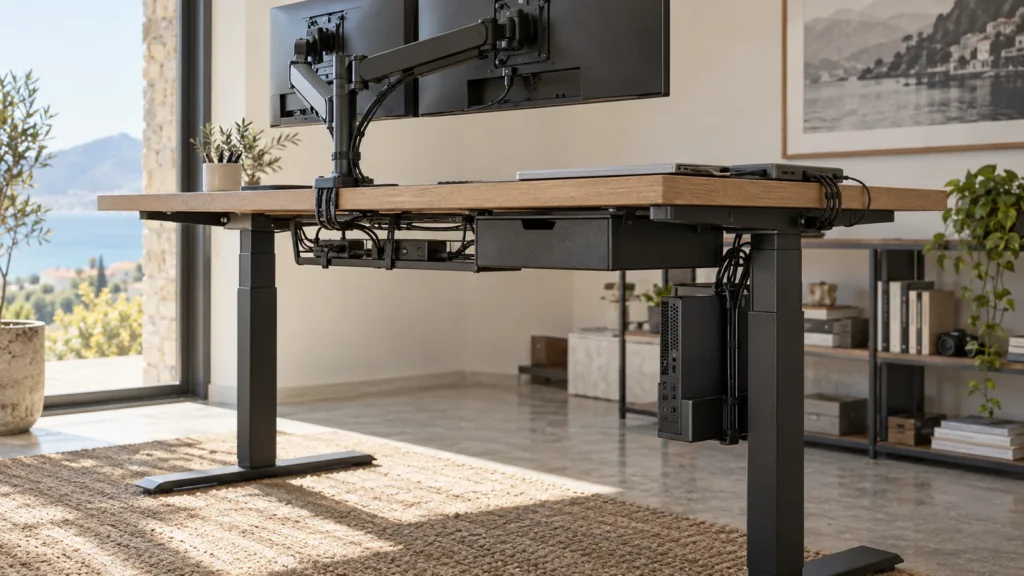
The advertised desk height is usually measured to the top of the work surface. It does not describe the opening below. Desktop thickness, support rails, drawers, modesty panels, height-adjustable frames and cable trays can all reduce usable clearance.
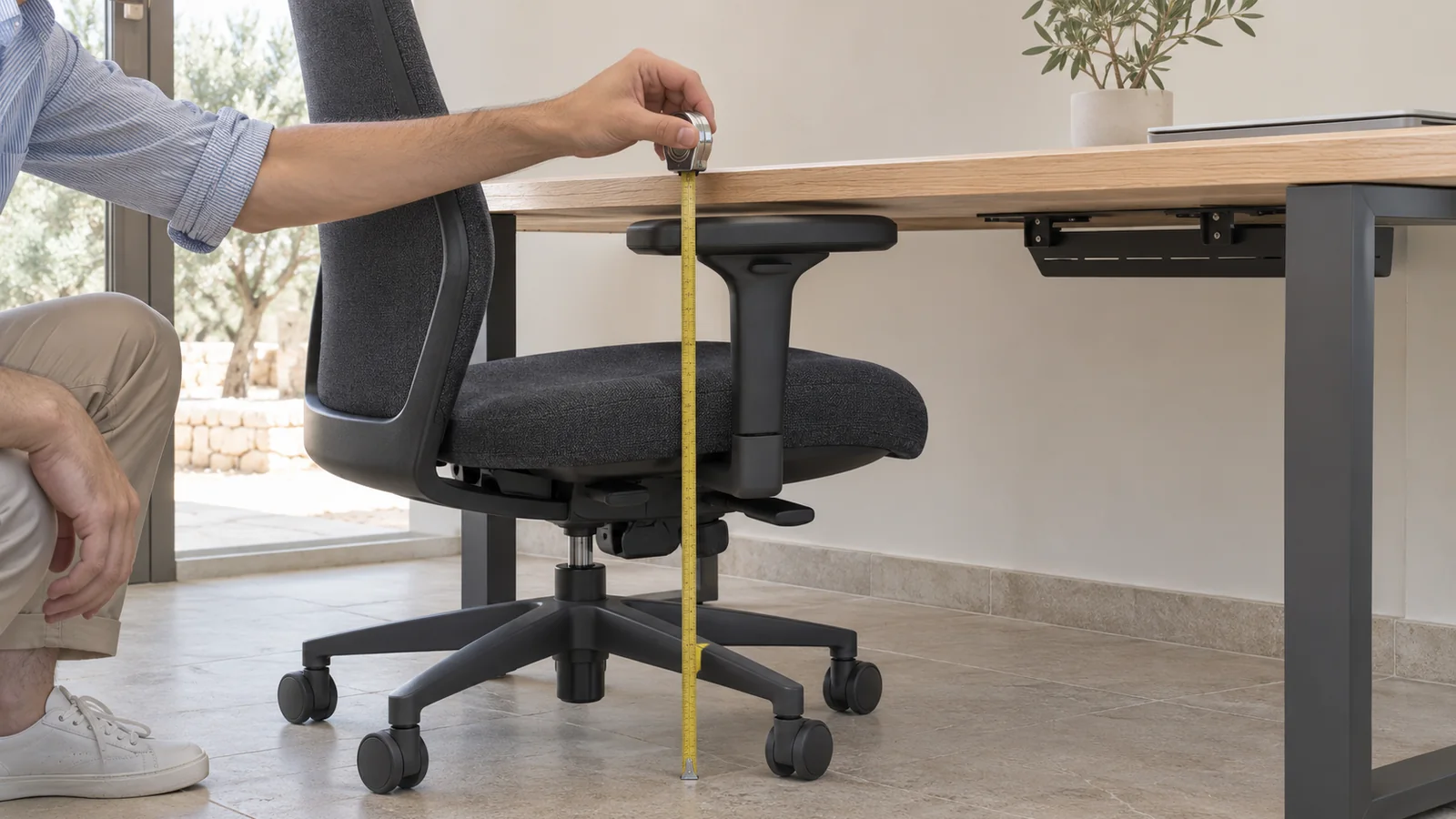
- Front underside: measure from the finished floor to the lowest point where the arm pads first enter.
- Deeper obstruction: record the height and distance from the front edge of every rail, tray or drawer in the chair’s path.
- Narrowest width: measure between legs, pedestal sides or brackets where the chair actually passes.
- Usable depth: note how far the chair may travel before the armrests, knees, base or other components meet an obstruction.
For a height-adjustable desk, repeat the check at the seated height used by each intended user or user group. A desk controller number is not a substitute for measuring the finished workstation, particularly where tops, frames and accessories were specified separately.
Attach every chair dimension to a setting
“Adjustable arms” is a feature description, not a compatibility result. The floor-to-arm-pad height changes with the seat setting, and some options also change arm width, angle or forward position. Ask for the exact chair version and arm configuration on the quotation.
The UK Health and Safety Executive advises that armrests should be set back or adjustable so the chair can be drawn close to the work surface. It also notes that armrests are not essential for most jobs and can restrict movement if poorly matched to the task. See HSE’s Seating at work guidance.
Working fit still begins with the person. HSE’s current display-screen setup guidance uses relaxed shoulders and a keyboard just below elbow height as practical reference points. Set the seat for the user first, then position the armrests, then test the desk clearance. Do not lower the chair into a poor working position simply to make the arms pass beneath the desk.
Use a clearance record, not one number
For vertical clearance, calculate the margin at each relevant obstruction:
Vertical margin = obstruction height from the floor − arm-pad height from the floor at the working setting
A negative result is a fail at that point. A positive result only confirms vertical clearance for the measured condition. It does not prove that the chair is narrow enough, that it can turn, or that the user can sit close enough to work. Do not create a universal minimum margin. Floors, upholstery compression, castors, production tolerances and the path of movement vary, so the sample workstation must verify any tight result.
| Record | Value to capture | Why it matters |
|---|---|---|
| Chair identity | Model, size, castor and exact arm option | Different configurations can have different widths and adjustment ranges. |
| User setting | Seat height and arm position used for the test | A lowest possible setting may be irrelevant to normal work. |
| Desk profile | Height and depth position of each underside obstruction | The front edge may clear while a deeper rail or tray blocks travel. |
| Movement envelope | Width, entry angle, swivel and recline used in the workstation | Static dimensions do not show the full path. |
Manufacturer specifications need the same care. Herman Miller’s official Aeron dimensions, for example, separate chair sizes and arm configurations, and list different overall widths for some options. The lesson is broader than one model: use the dimensions for the exact configuration being ordered, and confirm what each published arm measurement references before comparing it with a desk opening.
Worked example: 24 chairs, one hidden cable tray
This hypothetical example shows the approval method. The figures are illustrative and are not recommended workstation dimensions.
A Cyprus project is reviewing 24 chairs for a fixed bench. The desktop is 740 mm above the finished floor. Its front underside is 710 mm, but a cable tray sits 300 mm behind the front edge and its lowest point is 670 mm. The selected chair sample produces a floor-to-arm-pad height between 680 and 705 mm across the working settings used by two trial users.
| Check | Observed result | Procurement decision |
|---|---|---|
| Front-edge working fit | Vertical margin ranges from 5 to 30 mm. | Provisional pass, subject to a physical sample because the smaller margin is tight. |
| Deeper working fit | The arm pad is higher than the 670 mm cable tray at both working settings. | Fail. The chair cannot travel to the intended working depth. |
| Parking fit | The empty chair clears when the armrests are lowered. | Parking passes, but this does not resolve the working failure. |
| Movement fit | The chair turns between the bench legs, but the outer arm pad approaches a bracket. | Test the full swivel and entry path in one completed bay. |
The appropriate response is not to tell every user to lower the chair. The team should review an approved relocation or alternative cable-management detail, a compatible arm configuration, or a different desk-chair pairing. Only after one completed bay passes in the intended working settings should the remaining 23 chairs be released.
When armrests are the wrong specification
Armrests can be useful, but they are not automatically suitable for every task or desk. Consider another configuration when fixed arms prevent close access, the user needs frequent lateral movement, a shared workstation must serve a wide range of users, or under-desk equipment leaves no compatible path.
Do not remove arms, desk rails or cable-management parts unless the relevant manufacturer permits the change. A rotating arm pad is also not the same as a genuine fold-away mechanism. If a project depends on an arm moving fully clear, make that function an order-line requirement and test the exact version.
Put the test into the chair schedule
A useful procurement line should require more than “adjustable arms”. Record:
- the chair model, size and complete arm option;
- the seat-height and arm settings used for the trial;
- floor-to-arm-pad height at each working setting;
- the lowest desk obstruction, its depth from the front edge and the narrowest clear width;
- a separate result for working, parking and movement fit;
- the sample workstation, floor finish and accessories used;
- the person responsible for approving any change to the chair, desk or cable tray.
For a moving work surface, combine this check with the standing desk handover checklist, since the relationship changes through the desk’s travel. For a fixed workstation, one completed sample bay is usually the clearest place to resolve the fit before volume release.
Studio Office’s office seating range includes different arm options and chair sizes, while the desk range uses different frames and cable-management details. Send the exact chair configuration and a section through the desk if you want the pairing checked as part of a Cyprus workplace quotation.