A team of 80 does not automatically need 80 office lockers. If only 45 people attend on the busiest day, a one-to-one allocation may consume space that could serve the workplace better. Yet ordering 45 compartments can still fail when attendance is concentrated, some roles need permanent storage, or helmets and laptop bags do not fit the chosen doors.
The reliable way to specify locker capacity is to separate permanent users from day users, plan from observed peak attendance rather than the weekly average, and reserve a small number of compartments for operational exceptions. Only then should you choose compartment sizes, materials and locks.
The capacity calculation
Use one line that everyone on the project can audit:
Required compartments = permanently assigned users + peak shared users + operational reserve + special-purpose compartments
Each term answers a different question. Mixing them into a single employee-to-locker ratio hides the decisions that cause shortages later.
- Permanently assigned users: people whose role, equipment or working pattern justifies a compartment that remains theirs.
- Peak shared users: the highest credible number of unassigned people who need storage at the same time. Use attendance records or booking data for representative weeks, not an average day.
- Operational reserve: spare capacity for new starters, broken locks, delayed clear-outs and unexpected attendance. Set and document the percentage rather than adding an unexplained allowance.
- Special-purpose compartments: storage for visitors, couriers, shared devices, protective equipment or other uses that should not compete with personal lockers.
If attendance is still changing, calculate more than one scenario. A base case might use the 90th percentile of observed attendance, while a stress case uses the highest recorded day. This is a planning choice, not a universal standard. The project team should choose the service level and record the evidence behind it.
Choose the storage promise before the product
| Service model | What the user receives | Where it works | Main failure to prevent |
|---|---|---|---|
| Assigned | The same compartment every day | Regular office-based staff, role-specific equipment, long-term storage | Empty compartments stay unavailable when their users are absent |
| Shared day use | Any free compartment for the visit | Hybrid teams with reliable attendance data and a clear daily release rule | Items are left overnight, so apparently free capacity disappears |
| Mixed | Permanent storage for defined roles plus a shared pool | Workplaces with several attendance patterns | The assigned group expands informally and erodes the shared pool |
The mixed model often deserves testing because it makes exceptions visible. It also prevents the needs of a field technician, receptionist or employee with specialist equipment from dictating a one-to-one policy for the whole organisation.
Manufacturers distinguish between storage for anchored and hybrid workers, and between individual and keyless locking options. For example, Steelcase describes its Universal Lockers for both anchored and hybrid users. That supports the distinction, but it does not determine your quantity. Your attendance and storage policy do.
A worked example for a 72-person workplace
Consider a hypothetical business with 72 employees:
- Twelve people need permanent compartments because they work mainly on site or store role-specific items.
- Among the other 60 people, the highest credible shared demand from the attendance sample is 38.
- The team sets a reserve of 10% of shared demand. Rounding up, that adds four compartments.
- Four more compartments are set aside for visitors and shared devices.
The calculation is 12 + 38 + 4 + 4 = 58 compartments. That is 14 fewer than a one-to-one allocation, but 13 more than simply copying the busiest recorded headcount of 45. The difference comes from stating the service promise and the exceptions rather than treating every user as identical.
Before ordering 58 identical doors, split the total by what must fit inside. The capacity calculation counts compartments; the next step determines their useful sizes.
Size compartments from real item sets
A locker described as “personal storage” may need to hold very different combinations. Build a short item schedule for each user group:
- laptop, charger and small shoulder bag;
- backpack plus motorcycle or bicycle helmet;
- coat, footwear or a change of clothes;
- files, samples or tools that must remain upright;
- shared devices that require power, ventilation or controlled access.
Then ask the supplier for internal clear dimensions, not only the external cabinet size. Hinges, lock bodies, shelves and door returns can reduce the usable opening. A sample-fit test with the largest real bag, helmet or device is more dependable than choosing from a photograph.
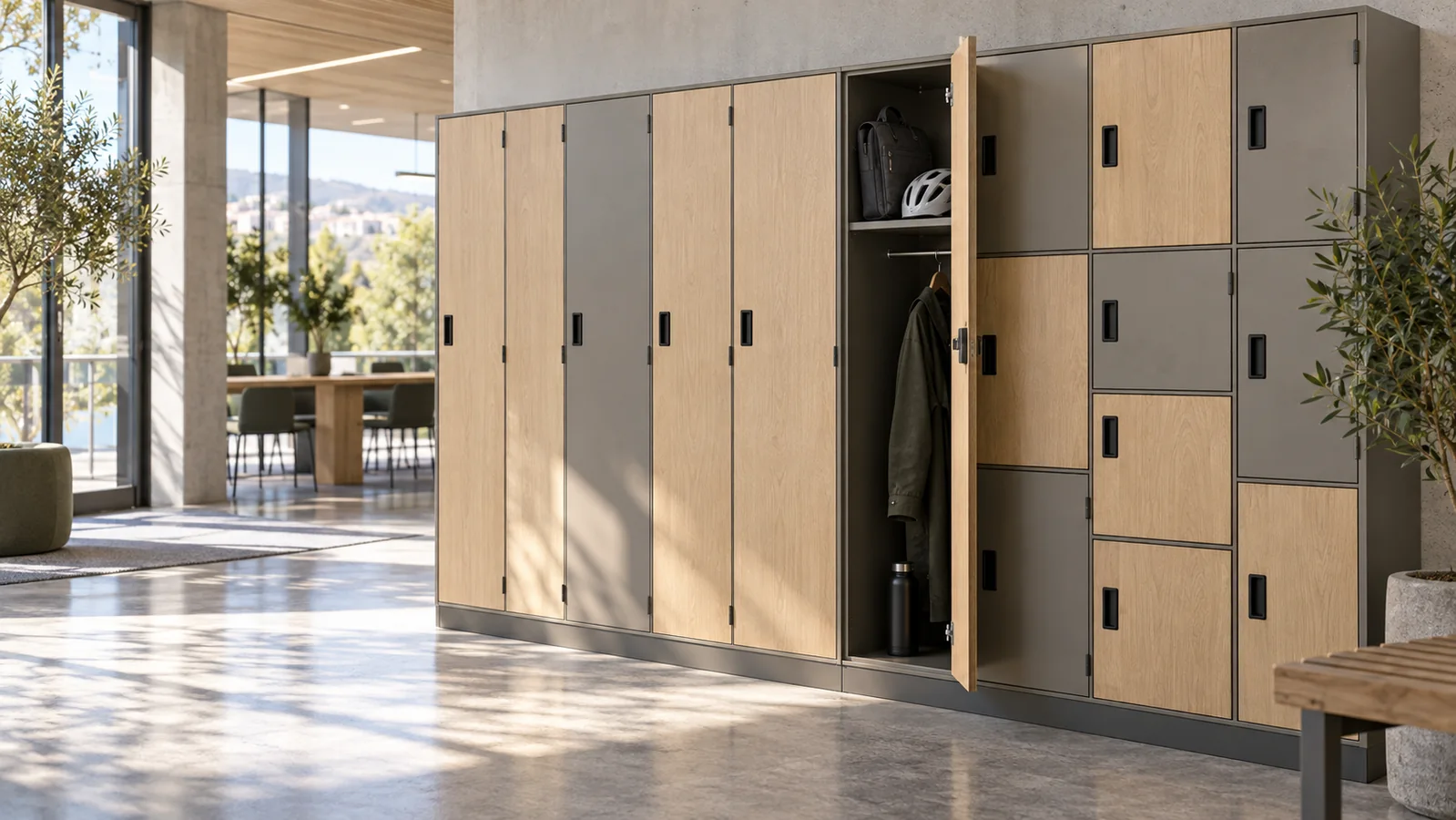
Studio Office’s current range shows why this step matters. Steel staff and changing-room lockers include several tier arrangements, while Compact HPL lockers are planned with full-height or two-tier compartments. These are different planning tools. The correct format follows the item schedule and setting.
Place lockers where the routine actually happens
Location changes how much capacity feels usable. A single bank near the entrance can suit day users who deposit a bag once and collect it when leaving. Distributed banks can reduce walking for teams spread across floors, but they also create separate pools. Ten empty compartments on another floor may not solve a shortage where a team arrives.
Mark the full locker depth, open-door swing and a person standing at the door on the plan. Check that two users can access adjacent compartments without blocking the main route. Keep doors and waiting users clear of required escape routes and accessible circulation, with the project designer confirming the applicable requirements for the site.
A lock is also an operating process
A key lock can be straightforward, but someone must control spare keys and replacements. A keypad or RFID system can support shared use, yet it needs a defined reset and override process. Digilock’s own guidance distinguishes shared use from assigned use, and its override instructions confirm that manager credentials form part of the system. This is a useful procurement reminder: specify administration as well as the user credential.
Before selecting the hardware, name the person responsible for:
- issuing and recovering keys, codes or cards;
- opening a compartment when a credential is lost;
- clearing items left after the permitted period;
- keeping manager credentials secure;
- replacing batteries and recording maintenance where electronic locks are used;
- deciding whether access events are recorded and, if they are, setting an appropriate privacy and retention process.
The information a useful quotation should contain
A clear brief makes competing quotations easier to compare. Include:
- assigned, shared and special-purpose quantities;
- the attendance period and peak measure used;
- the reserve percentage and its reason;
- item sets and minimum clear internal dimensions;
- full-height, tiered or mixed compartment schedule;
- lock mode, credentials, manager override and spare-key process;
- numbering or wayfinding requirements;
- material, finish, ventilation and cleaning requirements;
- wall, floor or bank-to-bank fixing method;
- site dimensions, access constraints and responsibility for final measurement.
Do not approve the schedule from a door count alone. Ask for an elevation that labels every compartment type and a plan showing the bank with doors open. That drawing becomes the common reference for the furniture supplier, designer, facilities team and installer.
When one locker per person is still the right answer
A one-to-one allocation can be sensible when most employees attend daily, belongings remain overnight, roles require dedicated equipment, or the organisation values a permanent personal base more than reducing the locker footprint. The capacity method does not force a lower ratio. It makes the cost and service decision explicit.
If your workplace has several attendance patterns, prepare the four-part calculation and the item schedule before discussing finishes. Studio Office can then assess the layout against its office locker options. For a project-specific configuration, request a quotation with your headcount, peak attendance, floor plan and list of items to be stored.