A desk can be electrically adjustable and still fail the people who need to use it. Its lowest position may leave a shorter colleague reaching up to the keyboard, while its highest position may leave a taller colleague leaning forward. Memory presets cannot recover height that the frame does not provide.
Before comparing motors, controls or finishes, convert the intended users and equipment into one procurement question: does the delivered standing desk height range include the lowest seated working position and the highest standing working position the project requires? This article sets out a practical way to answer that question before an order is released.
First establish what the height range measures
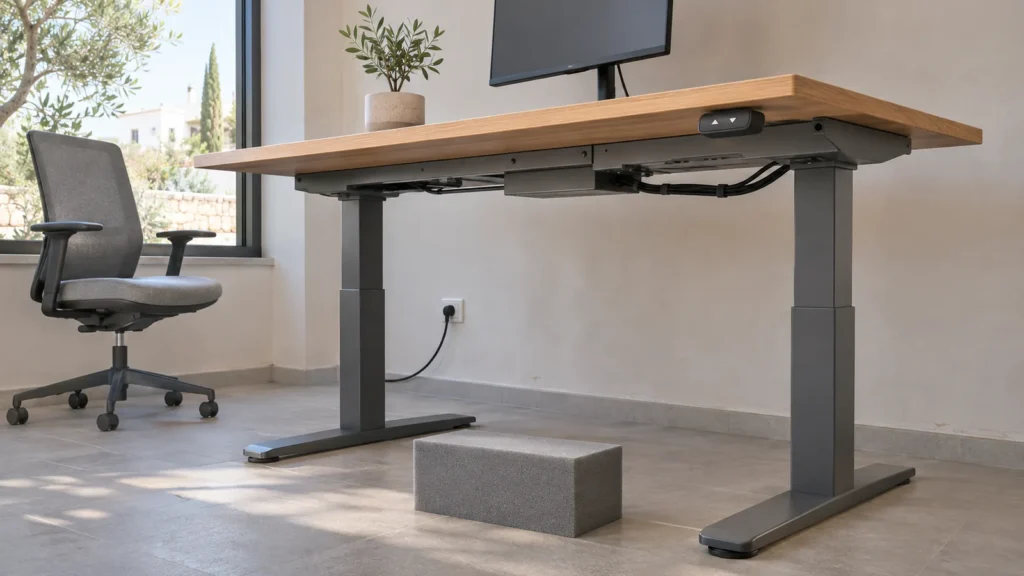
A range such as “700 to 1200 mm” is useful only when its reference points are clear. Depending on the document, it may describe the frame, the top of the finished work surface or the number shown by the controller. These are not automatically the same.
| Figure in the proposal | What it may describe | Что запросить |
|---|---|---|
| Frame height | The support structure before the selected worktop is added | The exact measuring points and how the chosen top changes the finished height |
| Work-surface height | Floor to the top of a stated worktop configuration | Confirmation that it applies to the ordered top, feet or castors and frame version |
| Controller display | A calibrated value used by the desk control | Whether it represents the finished surface and how calibration is checked after installation |
| Keyboard height | The level at which the hands actually work | The effect of a keyboard platform, thick input device or other accessory above or below the main top |
Ask the supplier to state the minimum and maximum delivered work-surface height for the precise configuration offered. A generic frame brochure is not enough if the project uses a different top, mobile feet or an accessory that changes the working level.
Measure working positions, not body height alone
Online height charts can be a rough starting point, but a procurement decision should use the people, tasks and equipment that the desk must accommodate. Two people of similar height may use different chair settings, keyboards or footwear. A drawing tablet or keyboard platform can also move the effective input surface away from the main worktop.
Set the seated position first
Adjust the chair for the user and task before moving the desk. As a practical reference, the UK Health and Safety Executive advises relaxed shoulders and a keyboard just below elbow height, with the seat supporting the thighs and the backrest supporting the lower back. See the HSE’s display-screen workstation guidance. It is a setup reference, not a substitute for an individual assessment where one is needed.
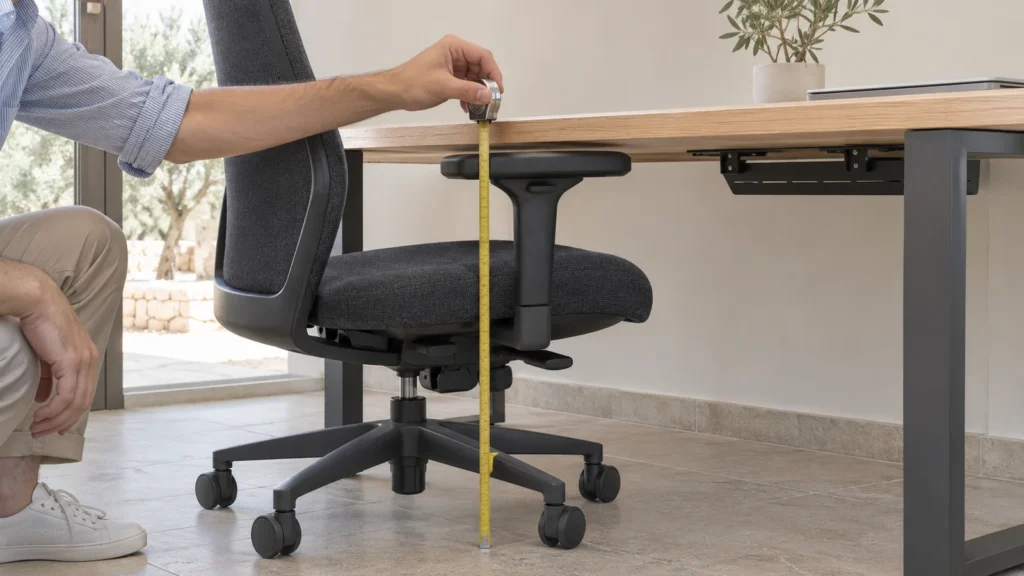
With the user in that position, bring a representative keyboard or input device to a comfortable working level. Measure from the finished floor to the surface that supports it. Record the chair, footwear, footrest and accessory configuration used in the test.
Repeat the test while standing
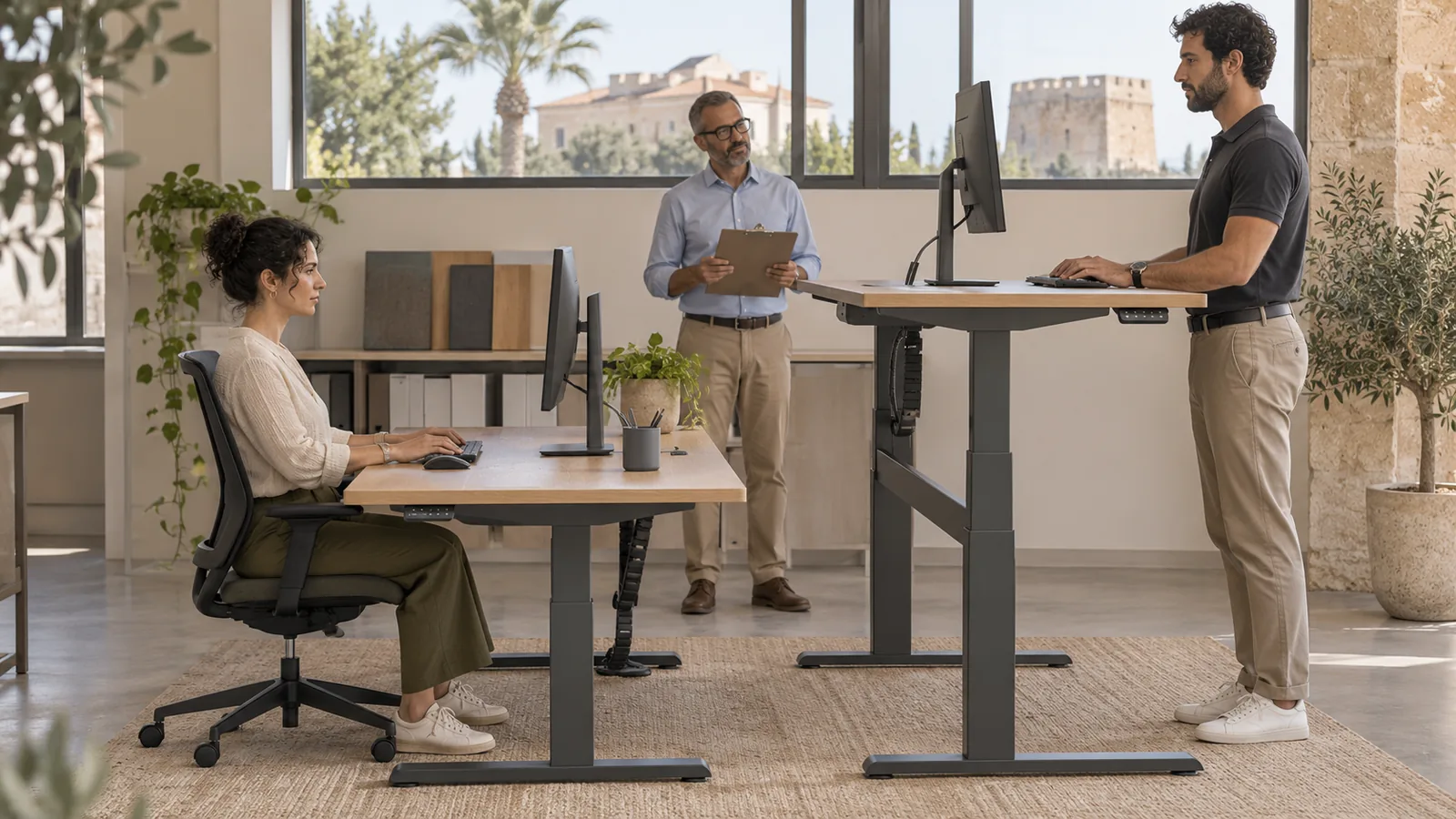
Standing is a separate working position, not the seated number with a standard allowance added. Set the keyboard and mouse for relaxed shoulders and normal use, then measure the same floor-to-input-surface dimension. Repeat the test for the tallest relevant user and for any task that changes the input device.
Define who the desk must serve
A desk assigned to one known person has a different requirement from a shared touchdown desk or a workstation that may change users. ISO 9241-5:2024 states that its ergonomic principles apply to the user requirements, design and procurement of workstation equipment used with visual displays. The official ISO abstract supports the key procurement point: define the user requirement before selecting the equipment.
For a shared project, test the lowest required seated position and the highest required standing position across the intended user group. If future users are unknown, agree how the range will be validated and whether a representative sample desk is required before volume release.
Build a four-line range schedule
The following schedule turns the trial into a pass or fail decision. Keep the measurements with the furniture specification rather than leaving them in informal notes.
| Запись | Definition | Evidence |
|---|---|---|
| L | Lowest required seated input-surface height | Named trial user or user group, chair and equipment configuration |
| H | Highest required standing input-surface height | Named trial user or user group, footwear and equipment configuration |
| Dmin | Lowest delivered finished work-surface height | Supplier document for the exact frame, top and feet or castors |
| Dmax | Highest delivered finished work-surface height | The same configuration and measuring reference as Dmin |
On paper, the range passes when Dmin is no higher than L и Dmax is no lower than H. Any keyboard platform or accessory that changes the input level must be included. A paper pass still needs a physical sample where the margins are tight or the workstation will be shared by a broad range of users.
Worked example: one missed endpoint is a failed range
Consider a hypothetical Cyprus office selecting desks for shared workstations. A trial finds that the lowest required seated input surface is 690 mm above the finished floor, while the highest required standing input surface is 1230 mm. These figures are illustrative and are not recommended dimensions.
| Candidate | Confirmed delivered range | Result |
|---|---|---|
| A | 710 to 1210 mm, finished work surface | Fails both endpoints: 20 mm too high at the low end and 20 mm too low at the high end |
| B | 620 to 1220 mm frame reference, plus a confirmed 30 mm top, giving 650 to 1250 mm finished height | Passes the paper range, subject to the supplier confirming those reference points and a sample check |
Candidate A does not become suitable because most users may fit it. The schedule says the shared desk must serve the tested envelope. Candidate B covers the endpoints, but it has not yet been approved for load, stability, clearances, cables or controls. The calculation answers one procurement question only.
Real products show why the exact configuration matters
Published ranges can differ within the same product category. The Studio Office Fly Lite Height Adjustable Desk is listed at 730 to 1210 mm with its 30 mm worktop. Herman Miller lists the Ratio height ranges as 700 to 1200 mm for the electric single-stage version and 650 to 1250 mm for the electric dual-stage version. Studio Office also presents the Ratio workstation in its desk range.
This is not a ranking of the two desks. It shows why “height adjustable” is not a complete specification. The required range, ordered configuration, availability and other performance criteria must be confirmed for the particular project.
Range is one gate in a wider desk approval
A desk with the right endpoints can still be unsuitable. The worktop must accommodate the equipment and task, the moving load must be understood, cables need enough travel, and the area above and below must remain clear. Controls must also be usable by the people assigned to the workstation.
Use the existing moving-load worksheet to check what the desk will actually lift, and the anti-collision commissioning plan to separate a safety feature from a clear travel path. After installation, the standing-desk handover checklist verifies the complete workstation with its real equipment and users.
Tender wording that makes the range testable
The height-adjustable desk shall provide a delivered finished work-surface range that includes the project’s recorded minimum seated and maximum standing input-surface requirements. The tender return shall state the measuring reference, frame version, selected worktop thickness, feet or castors and any accessory that changes the input level. Before volume release, the supplier shall provide the applicable technical evidence and, where requested, a representative sample for witnessed user-fit verification.
Adapt the wording to the contract and the project’s assessment process. Its purpose is to make the offered range traceable to the delivered desk, rather than to prescribe one universal height.
When a narrower range may still be appropriate
A narrower range can be suitable for a desk assigned to a known user whose measured positions fit comfortably, or for a standing collaboration point that is not intended to become a seated computer workstation. It is a weak choice for an unassigned desk when the project has not tested its user population, or when the only way to obtain a fit is to compromise the chair setting or normal task posture.
For a Cyprus workplace project, send Studio Office the intended users, desk sizes, equipment list and any tested seated and standing heights through the contact page. Ask for the finished range and its measuring reference to appear in the proposal for each desk configuration, so it can be checked before approval and again at handover.